Why AI-Enabled Eye Hospitals Are Attracting Medical Tourists
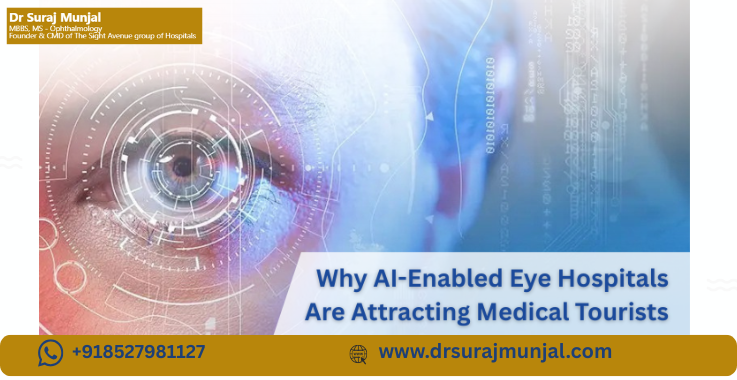
Table of Contents
Medical tourism is evolving rapidly across the world. Earlier, patients traveled abroad mainly to reduce treatment costs. Today, the decision is far more informed. International patients are looking for advanced technology, accuracy, safety, transparency, and predictable outcomes.
In the field of eye care, this shift is even more visible.
Across India, AI-enabled eye hospitals are emerging as global leaders in ophthalmology. These hospitals combine the expertise of experienced eye specialists with the power of Artificial Intelligence (AI) to deliver world-class eye care. As a result, patients from the Middle East, Africa, Europe, and Asia are increasingly choosing India for eye treatments.
Eye specialists like Dr. Suraj are at the forefront of this transformation, using AI to improve diagnosis, surgical precision, and long-term visual outcomes.
This detailed article explains why AI-enabled eye hospitals are attracting medical tourists, how AI is reshaping ophthalmology, and what makes India a trusted global destination for advanced eye care.
The Growing Importance of Eye Care in Medical Tourism
Vision plays a crucial role in everyday life. Any eye problem—whether minor or serious—can affect independence, productivity, and quality of life. This is why eye care has become one of the most sought-after specialties in medical tourism.
International patients commonly travel for:
- LASIK and refractive surgery
- Cataract surgery
- Retina treatments
- Glaucoma management
- Corneal procedures
- Pediatric eye care
Patients want treatments that are:
- Safe
- Precise
- Quick to recover from
- Long-lasting
AI has significantly raised the standard of eye care, making Indian eye hospitals highly attractive to medical tourists.
What Is an AI-Enabled Eye Hospital?
An AI-enabled eye hospital uses Artificial Intelligence to support eye specialists at every stage of patient care.
AI is used in:
- Eye scans and imaging analysis
- Early disease detection
- Surgical planning
- Outcome prediction
- Post-treatment monitoring
AI does not replace the eye doctor.
Instead, it acts as a powerful support system that helps doctors make more accurate and consistent decisions.
The real strength lies in the combination of:
Human expertise + AI precision
This balance is what international patients trust.
Why Medical Tourists Prefer AI-Enabled Eye Hospitals
Medical tourists face several concerns:
- Will the diagnosis be accurate?
- Will the surgery be safe?
- Will the outcome match expectations?
- What happens after I return home?
AI directly addresses these concerns.
AI-enabled eye hospitals offer:
- Better diagnostic accuracy
- Personalized treatment planning
- Higher surgical precision
- Faster recovery
- Reliable follow-up care
This makes AI hospitals a natural choice for international patients.
AI Makes Eye Diagnosis Faster and More Accurate
Accurate diagnosis is the foundation of successful eye treatment.
For medical tourists, diagnostic accuracy is critical because:
- They may not have multiple chances for evaluation
- They want clarity before traveling
- They want confidence in treatment decisions
AI helps deliver this confidence.
AI in Eye Imaging and Scan Analysis
AI systems analyze:
- OCT (Optical Coherence Tomography) scans
- Fundus photographs
- Corneal topography maps
- Visual field tests
These systems can detect early signs of:
- Cataracts
- Glaucoma
- Diabetic retinopathy
- Age-related macular degeneration
- Keratoconus
- Retinal vascular diseases
AI can identify micro-level changes that may not be easily visible to the human eye.
Benefits for Medical Tourists
For international patients, AI-based diagnosis means:
- Faster evaluation
- Reduced diagnostic errors
- Clear treatment plans
- Less uncertainty
This builds trust even before the patient travels to India.
AI-Enabled LASIK: A Major Attraction for Medical Tourists
LASIK and refractive surgeries are among the most popular eye procedures for medical tourists.
Patients want:
- Perfect vision
- Minimal risk
- Quick recovery
- Long-term stability
AI has transformed LASIK into a highly personalized and predictable procedure.
How AI Improves LASIK Surgery
AI helps eye specialists by:
- Mapping corneal shape with extreme precision
- Measuring corneal thickness accurately
- Detecting subtle irregularities
- Analyzing higher-order visual aberrations
Using this data, AI helps customize laser treatment for each individual eye.
Why International Patients Trust AI-LASIK
AI-guided LASIK offers:
- Better visual outcomes
- Lower complication rates
- Faster healing
- Higher patient satisfaction
For medical tourists, AI removes guesswork and increases confidence in results.
AI in Cataract Surgery: Precision Patients Can Rely On
Cataract surgery is one of the most common eye surgeries worldwide.
Modern patients expect more than just removal of the cloudy lens. They want:
- Clear distance and near vision
- Reduced dependence on glasses
- Long-lasting results
AI helps meet these expectations.
AI-Assisted Cataract Evaluation
AI evaluates:
- Lens opacity
- Eye length and curvature
- Astigmatism
- Retinal condition
This ensures accurate surgical planning.
AI and Intraocular Lens (IOL) Selection
AI helps eye specialists choose the most suitable IOL by analyzing:
- Eye anatomy
- Visual needs
- Lifestyle preferences
Whether monofocal, multifocal, or toric lenses, AI improves outcome predictability.
For medical tourists, this means:
- Clear expectations
- Better post-surgery vision
- Fewer surprises
AI in Retina Care: Protecting Vision for Life
Retinal diseases are among the leading causes of irreversible vision loss.
AI plays a critical role in managing:
- Diabetic retinopathy
- Macular degeneration
- Retinal vein occlusion
- Retinal tears and detachments
AI detects changes early, sometimes even before symptoms appear.
Why This Matters for Medical Tourists
Many international patients have chronic conditions like diabetes.
AI ensures:
- Early detection
- Timely treatment
- Long-term vision preservation
This reduces the risk of vision loss after patients return home.
AI in Glaucoma Care: Stopping Silent Blindness
Glaucoma often develops silently and causes irreversible damage.
AI helps by:
- Detecting early optic nerve damage
- Monitoring visual field progression
- Tracking eye pressure trends
For medical tourists, AI provides reassurance that no early warning signs are missed.
AI Improves Surgical Precision and Safety
Eye surgeries require extreme accuracy.
AI supports surgeons by:
- Enhancing microscopic precision
- Improving surgical planning
- Reducing human variability
This results in:
- Shorter surgery duration
- Less trauma to the eye
- Faster recovery
- Lower complication rates
International patients value this level of safety and consistency.
AI Helps Medical Tourists Before They Travel
One of the biggest challenges in medical tourism is deciding whether to travel.
AI-enabled eye hospitals offer:
- Remote evaluation of eye reports
- AI-supported second opinions
- Preliminary treatment plans
This allows patients to:
- Make informed decisions
- Understand treatment timelines
- Plan travel confidently
Transparency builds trust even before arrival.
AI Supports Post-Treatment Follow-Up Across Borders
Follow-up care is a major concern for medical tourists.
AI helps by:
- Monitoring recovery remotely
- Analyzing follow-up scans
- Detecting complications early
Patients remain connected to their eye specialist even after returning home.
AI Enhances Patient Experience for International Visitors
Faster Care and Less Waiting
AI automates:
- Appointments
- Diagnostics
- Reporting
This reduces waiting time and shortens hospital visits.
Better Communication and Education
AI tools assist with:
- Language translation
- Digital instructions
- Patient education materials
International patients feel informed and comfortable throughout their journey.
Cost Transparency and Trust Through AI
AI helps hospitals:
- Predict treatment costs accurately
- Avoid unnecessary investigations
- Reduce complications
This ensures:
- Transparent pricing
- Fewer unexpected expenses
- Better financial planning for patients
Cost clarity is a major reason medical tourists choose AI-enabled hospitals.
Why India Leads in AI-Enabled Eye Care
India offers a unique combination of:
- Highly skilled eye specialists like Dr. Suraj
- Advanced AI technology
- International treatment standards
- Affordable healthcare costs
This makes India one of the most trusted destinations for eye care medical tourism.
Ethical and Responsible Use of AI in Eye Care
AI is always used:
- Under doctor supervision
- With strict data privacy protocols
- Following ethical medical guidelines
Final medical decisions always rest with qualified eye specialists.
The Future of AI-Enabled Eye Hospitals
In the coming years, AI will:
- Detect eye diseases even earlier
- Improve surgical outcomes further
- Expand remote eye care services
- Personalize vision treatment
Medical tourism in ophthalmology will continue to grow as trust in AI increases.
Human Expertise + AI: The Perfect Balance
Despite technological advances, eye care remains deeply human.
Compassion, experience, and judgment cannot be automated.
The future lies in AI-supported expertise, where eye specialists like Dr. Suraj use advanced technology to deliver safe, precise, and compassionate care.
Conclusion
AI-enabled eye hospitals are redefining global eye care and transforming medical tourism.
They offer:
- Accurate diagnosis
- Personalized treatment
- Safer surgeries
- Reliable follow-up
For medical tourists, choosing an AI-enabled eye hospital in India means choosing clarity, confidence, and quality.
With experienced eye specialists like Dr. Suraj, supported by Artificial Intelligence, patients can trust that their vision is in the safest and most capable hands.