Beyond LASIK: Understanding Implantable Collamer Lenses (ICL) for Vision Correction
Table of Contents
Vision correction technology has advanced far beyond traditional glasses and contact lenses. While LASIK remains one of the most well-known options, it’s not ideal for everyone—especially those with thin corneas, high prescriptions, or dry eyes. Enter Implantable Collamer Lenses (ICL)—a groundbreaking, safe, and reversible procedure that offers ultra-clear vision without removing corneal tissue. In this blog, we explore how ICL works, its advantages, and why it’s becoming the preferred choice for many patients at the care of Dr. Suraj Munjal, a leading ophthalmologist in India.
What is an Implantable Collamer Lens (ICL)?
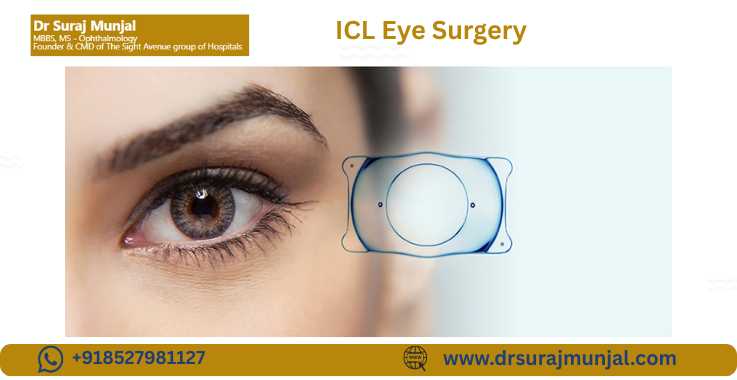
An Implantable Collamer Lens (ICL) is a state-of-the-art vision correction option designed for individuals who are nearsighted and may not be suitable candidates for LASIK. Made from a biocompatible material called Collamer—a collagen co-polymer—the lens is soft, flexible, and designed to work in harmony with your eye.
Unlike contact lenses that rest on the eye’s surface or LASIK that permanently alters the cornea, the ICL is surgically placed inside the eye between the iris (colored part of the eye) and the eye’s natural lens. It functions like an internal contact lens, providing permanent vision correction while maintaining the eye’s natural structure.
ICLs are especially effective for correcting moderate to high degrees of myopia (nearsightedness) and are FDA-approved as a long-term solution for those looking to eliminate dependency on glasses or contact lenses. Since the lens is placed internally and doesn’t involve removing corneal tissue, it is also reversible and can be removed or replaced if needed in the future.
How is ICL Different from LASIK?
ICL and LASIK are both advanced procedures designed to correct vision problems like nearsightedness, but they work in fundamentally different ways and are suited for different patient profiles.
LASIK:
- Involves creating a flap in the cornea and reshaping the underlying corneal tissue with a laser.
- It is permanent and not reversible.
- Suitable primarily for patients with mild to moderate refractive errors and thick corneas.
- May cause or worsen dry eyes in some patients.
ICL:
- Involves placing a soft, biocompatible lens inside the eye between the iris and the natural lens.
- Does not remove or alter corneal tissue.
- Is reversible and can be removed or upgraded if necessary.
- Ideal for patients with high degrees of myopia, thin corneas, or dry eye conditions.
In summary, while LASIK is effective and widely used, ICL offers a safer, less invasive, and more versatile alternative for patients who are not ideal candidates for laser-based surgery.
Who is an Ideal Candidate for ICL?
ICL surgery is not for everyone, but it’s an excellent option for individuals who meet certain medical and visual criteria. It is especially recommended for patients who are not suitable candidates for LASIK or other laser-based vision correction surgeries.
You may be a good candidate for ICL if you:
- Are between 21 and 45 years old
- Have a stable prescription for at least 6 to 12 months
- Suffer from moderate to high myopia (nearsightedness ranging from -3.0 to -20.0 diopters)
- Have thin corneas that may not support LASIK
- Experience chronic dry eyes, making laser surgery risky
- Have a healthy eye structure with no history of glaucoma, uveitis, or retinal problems
It is important to note that ICL is currently not used to correct hyperopia (farsightedness) or significant astigmatism in most cases, although newer advancements are emerging.
A comprehensive eye exam conducted by a specialist like Dr. Suraj Munjal will determine whether ICL is the right choice for your vision needs. He will evaluate your corneal thickness, eye pressure, pupil size, and retinal health before recommending the procedure.
The ICL Procedure: Step-by-Step
The ICL procedure is a quick and painless outpatient surgery designed to provide long-lasting vision correction without reshaping the cornea. It typically takes about 20 to 30 minutes per eye and is performed under local or topical anesthesia. Here’s what you can expect:
Preoperative Preparation:
- A thorough eye examination is done to assess your eligibility.
- Measurements are taken to customize the ICL for your eye.
- Antibiotic and anti-inflammatory eye drops may be prescribed a day before surgery.
Surgical Process:
- Anesthesia: Numbing drops are applied to ensure comfort throughout the procedure.
- Small Incision: A micro-incision is made at the edge of the cornea.
- Lens Insertion: The folded ICL is gently inserted through the incision.
- Lens Positioning: The surgeon carefully positions the lens behind the iris and in front of your natural lens.
- Final Adjustments: No stitches are required; the tiny incision self-seals.
Post-Procedure:
- Vision begins to improve within a few hours, with most patients experiencing clear vision by the next day.
- You may be prescribed eye drops to prevent inflammation and infection.
- Protective eyewear may be provided for the first 24–48 hours.
The entire process is safe, efficient, and offers fast visual recovery, especially when performed by an expert like Dr. Suraj Munjal.
Benefits of Choosing ICL
Choosing Implantable Collamer Lens (ICL) surgery offers several advantages over traditional refractive surgeries like LASIK, especially for those who may not be eligible for corneal reshaping procedures. Here are some of the top benefits:
- High-Definition Vision: ICL provides sharp, crisp visual outcomes, often better than what glasses or contact lenses can achieve.
- Treats High Degrees of Myopia: ICL can correct very high prescriptions (up to -20.0 D), making it ideal for patients with extreme nearsightedness.
- No Dry Eye Complications: Unlike LASIK, ICL does not disrupt corneal nerves, significantly reducing the risk of dry eye syndrome post-surgery.
- Preserves Corneal Tissue: The cornea remains untouched, making the procedure suitable for patients with thin or irregular corneas.
- Reversible and Removable: If needed, the lens can be removed or replaced in the future, allowing flexibility as technology or the patient’s vision changes.
- Fast Recovery Time: Most patients experience significant improvement in vision within a day or two, with minimal discomfort.
- UV Protection: The collamer material contains UV-blocking properties to help protect the eyes from harmful rays.
Because of these advantages, ICL is increasingly recommended for patients who are looking for a long-term, effective, and less invasive alternative to LASIK.
Potential Risks and Considerations
Like any surgical procedure, ICL implantation comes with potential risks, although serious complications are rare, especially when performed by an experienced surgeon like Dr. Suraj Munjal. It is important for patients to be fully informed of the risks before undergoing surgery.
Common Risks Include:
- Glare or Halos Around Lights: Some patients may notice glare or halos, especially at night. These symptoms usually decrease over time.
- Elevated Intraocular Pressure (IOP): A temporary rise in eye pressure may occur post-surgery. This is monitored during follow-up visits and managed with medications if needed.
- Cataract Formation: There is a small chance that the implanted lens may accelerate the development of cataracts over time.
- Infection or Inflammation: Though extremely rare, any intraocular procedure carries a small risk of infection. This is minimized with proper sterilization and post-operative care.
- Lens Misalignment: In a few cases, the ICL may shift from its ideal position and require repositioning.
Dr. Suraj Munjal ensures that patients undergo comprehensive screening before surgery and receive thorough post-operative care to minimize these risks. Discussing your health history and concerns openly during the consultation will help ensure a safe and successful outcome.
ICL Recovery and Aftercare
Recovery from ICL surgery is typically smooth and quick, especially when proper aftercare instructions are followed. Most patients report a noticeable improvement in vision within 24 hours. However, healing can vary slightly depending on the individual.
Key Recovery Guidelines:
- Avoid rubbing your eyes: This is especially important during the first 1–2 weeks to avoid displacing the lens.
- Use prescribed medications: Antibiotic and anti-inflammatory eye drops should be used as directed to prevent infection and promote healing.
- Limit physical activity: Avoid swimming, contact sports, and heavy exercise for at least two weeks.
- Protect your eyes: Wear sunglasses when going outdoors and avoid dusty or smoky environments.
- Attend follow-up visits: Regular check-ups with your ophthalmologist are essential to ensure that the lens remains in the correct position and that your eye is healing properly.
Cost of ICL Surgery in India
Implantable Collamer Lens (ICL) surgery offers a long-term solution for vision correction, especially for individuals unsuitable for LASIK. India has emerged as a preferred destination for ICL surgery due to its combination of advanced medical facilities and cost-effectiveness.
Average Cost Range
The cost of ICL surgery in India varies based on several factors, including the type of lens used, the surgeon’s expertise, and the location of the clinic. On average, the cost ranges between ₹75,000 to ₹1,50,000 per eye .
City-wise Cost Breakdown
Here’s a general overview of ICL surgery costs in major Indian cities:
- Delhi: ₹90,000 – ₹1,50,000 per eye
- Mumbai: ₹1,00,000 – ₹1,60,000 per eye
- Bangalore: ₹85,000 – ₹1,40,000 per eye
- Chennai: ₹80,000 – ₹1,30,000 per eye
- Hyderabad: ₹75,000 – ₹1,25,000 per eye
- Kolkata: ₹80,000 – ₹1,35,000 per eye
- Pune: ₹85,000 – ₹1,40,000 per eye
Note: These are approximate costs and can vary based on the clinic and specific patient requirements.
Factors Influencing the Cost
Several elements contribute to the overall cost of ICL surgery:
- Type of Lens: Toric lenses, designed to correct astigmatism, are generally more expensive than standard lenses.
- Surgeon’s Expertise: Highly experienced surgeons may charge more for their services.
- Clinic Infrastructure: Clinics equipped with advanced technology and facilities might have higher charges.
- Pre and Post-operative Care: Comprehensive packages that include consultations, tests, and follow-ups can influence the total cost.
Insurance and Financing Options
Typically, ICL surgery is considered an elective procedure and may not be covered by standard health insurance policies. However, some insurance plans might offer partial coverage or reimbursements. Additionally, many clinics provide financing options, including EMI plans, to make the procedure more accessible to patients.
Why Choose Dr. Suraj Munjal for ICL Surgery?
Choosing the right eye surgeon is crucial for a successful and safe ICL procedure. Dr. Suraj Munjal is a highly respected ophthalmologist in India known for his excellence in advanced vision correction surgeries, including LASIK and ICL. He leads the team at Sight Avenue Eye Hospital, a center recognized for offering world-class eye care using cutting-edge technology.
Here’s why Dr. Munjal is trusted by thousands of patients from India and abroad:
- Extensive Experience: With years of experience and specialized training in refractive surgery, Dr. Munjal has successfully performed numerous ICL procedures.
- Modern Technology: Sight Avenue Eye Hospital is equipped with state-of-the-art diagnostic and surgical tools, ensuring precision and safety at every step.
- Personalized Consultation: Dr. Munjal offers one-on-one consultations to help patients understand the procedure, set realistic expectations, and make informed decisions.
- Transparent Pricing: The clinic provides clear cost estimates with no hidden fees, making world-class care affordable.
- International Patient Services: The hospital caters to international patients with personalized assistance, travel support, and post-operative follow-up.
- High Success Rates: Patient satisfaction and surgical outcomes are consistently excellent, with minimal complications and long-lasting results.
To book a consultation or learn more about ICL surgery with Dr. Suraj Munjal, visit the Sight Avenue Eye Hospital website or schedule an appointment today.