Refractive Lens Exchange (RLE) Surgery Cost in India
The cost of Refractive Lens Exchange (RLE) surgery in India ranges between ₹65,000 to ₹1,50,000 per eye, depending on the type of intraocular lens (IOL) selected. For both eyes, the total cost typically falls between ₹1,30,000 to ₹3,00,000, which is equivalent to around $1,600 to $3,600 for international patients.
India offers a significant price advantage over Western countries while maintaining world-class surgical expertise, FDA-approved technologies, and internationally accredited hospitals. Many of the same IOLs used in the US or Europe, such as multifocal, trifocal, and extended depth-of-focus lenses, are available at a fraction of the cost in India.
Patients over the age of 40, especially those with presbyopia or high hyperopia who are not eligible for LASIK or SMILE, find RLE a life-changing solution. With its affordability and advanced infrastructure, India has become one of the most popular destinations globally for patients seeking permanent spectacle-free vision correction through RLE.
Table of Contents
What Is Refractive Lens Exchange (RLE) Surgery?
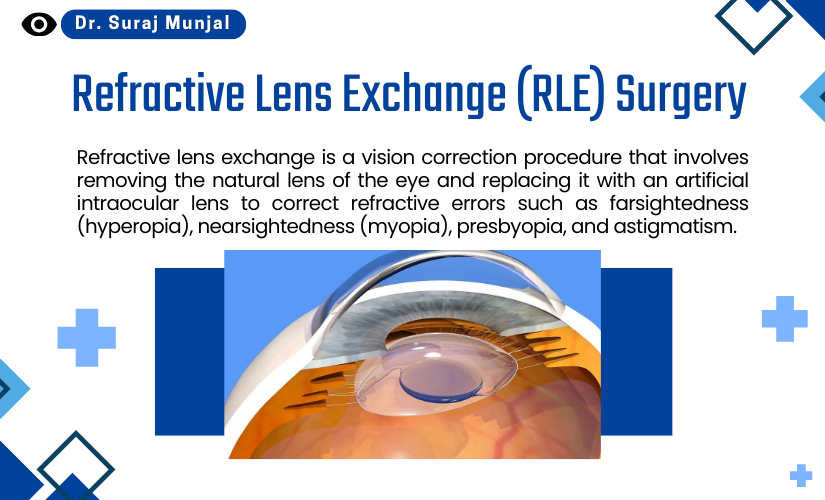
Refractive lens exchange is a vision correction procedure that involves removing the natural lens of the eye and replacing it with an artificial intraocular lens to correct refractive errors such as farsightedness (hyperopia), nearsightedness (myopia), presbyopia, and astigmatism.
It is essentially the same surgical technique used in modern cataract surgery. However, in RLE, the natural lens is still clear and is removed electively to eliminate the need for glasses or contact lenses.
How RLE Differs from LASIK or SMILE
- No laser reshaping of the cornea is involved.
- It is ideal for patients above 40, especially those with presbyopia (age-related reading vision loss).
- RLE also prevents cataracts in the future, as the natural lens is already replaced.
During the procedure, the surgeon uses a microscopic incision to remove the natural lens and insert a customized artificial lens (monofocal, multifocal, or trifocal IOL). These lenses are designed to offer clear vision at one or multiple distances, depending on patient needs.
RLE is a permanent solution, unlike LASIK or contact lenses, and does not regress over time. It’s especially suitable for those looking to be glasses-free for both distance and near vision, and it also corrects astigmatism when combined with toric IOLs.
Who Is a Good Candidate for RLE?
Refractive lens exchange is specifically designed for people who want to reduce or eliminate their dependence on glasses or contact lenses, especially those who are not suitable candidates for LASIK, SMILE, or PRK due to age or eye conditions.
You may be an ideal candidate for RLE if you meet the following criteria:
- Age Above 40: RLE is particularly beneficial for patients over 40 years of age who are experiencing presbyopia, or the natural age-related decline in near vision. Unlike LASIK, which doesn't correct presbyopia, RLE replaces the lens altogether.
- High Hyperopia or Myopia: Patients with extreme farsightedness (hyperopia) or significant nearsightedness (myopia) often don’t qualify for laser vision correction. RLE offers precise correction regardless of corneal thickness.
- Not Eligible for Laser Eye Surgery: If you have a thin cornea, dry eye syndrome, or irregular corneal topography, RLE provides a safer and more predictable alternative to LASIK or SMILE.
- Desire to Eliminate Cataract Risk: Since the natural lens is replaced with an artificial one, RLE eliminates the possibility of cataract formation in the future. It is a long-term benefit for patients in their 40s or 50s.
- Stable Vision and No Active Eye Disease: Your vision should be stable for at least one year, and your eyes should be free of active diseases such as uncontrolled glaucoma, retinal disorders, or severe diabetic retinopathy.
RLE is not typically recommended for patients under 35, unless there is a compelling medical reason. An ophthalmologist will conduct a comprehensive eye evaluation to determine if RLE is appropriate for your condition and expectations.
What are the Different Types of Lenses Used in RLE?
The success and satisfaction of refractive lens exchange surgery largely depend on the type of intraocular lens chosen. In India, patients have access to a wide variety of premium lenses that are also used in the most advanced eye hospitals globally. The main types of IOLs used in RLE are:
Monofocal Lenses
These lenses are designed to provide clear vision at one distance, typically for far vision. Patients may still need to use reading glasses for near or intermediate tasks.
Best for: Patients who want excellent distance vision and don’t mind wearing glasses for reading.
Cost: ₹65,000 – ₹80,000 per eye
Multifocal Lenses
Multifocal IOLs provide vision at multiple distances (near, intermediate, and far) by using various focal zones. They reduce the dependence on glasses but may cause glare or halos in some patients, especially at night.
Best for: Patients who want reduced dependency on glasses for both reading and distance tasks.
Cost: ₹80,000 – ₹1,10,000 per eye
Trifocal Lenses
Trifocal IOLs offer enhanced vision correction across all three ranges (far, intermediate, and near) with more seamless visual transitions. These are among the most advanced lenses used in RLE today.
Best for: Patients who want spectacle independence for all daily activities, including reading, driving, and screen use.
Cost: ₹1,00,000 – ₹1,50,000 per eye
EDOF (Extended Depth of Focus) Lenses
These lenses extend the range of clear vision rather than splitting light into zones like multifocal lenses. They provide smooth, continuous focus from far to intermediate vision, and moderate near vision with fewer night vision side effects.
Best for: Patients with active lifestyles who prioritize distance and intermediate vision with fewer halos or glare.
Cost: ₹1,00,000 – ₹1,50,000 per eye
Toric Lenses (for Astigmatism Correction)
These lenses are available in monofocal, multifocal, and trifocal designs and are used to correct astigmatism in patients with irregular corneas.
Best for: Patients with significant astigmatism who want sharp vision and minimal distortion.
All lenses are biocompatible, long-lasting, and designed to remain inside the eye permanently, providing stable vision for life. Your ophthalmologist will recommend the best IOL based on your vision goals, lifestyle, and eye health.
How Is RLE Surgery Performed?
Refractive lens exchange surgery is a quick and highly refined procedure, very similar to cataract surgery, but performed on clear (non-clouded) lenses to correct refractive errors. The goal is to replace the natural lens of the eye with a high-performance artificial lens that eliminates the need for glasses or contact lenses.
- Pre-operative Assessment: Before surgery, you’ll undergo a detailed eye examination that includes refraction testing (to measure your prescription), corneal topography (to map the cornea), optical biometry (to determine lens power), and dry eye evaluation. Your surgeon will also discuss your visual goals and lifestyle to choose the most suitable IOL.
- Anesthesia and Eye Preparation: On the day of surgery, you’ll receive numbing eye drops (no injections or general anesthesia needed). The area around the eye is cleaned, and a lid speculum is used to keep the eye open. The procedure is painless and takes about 15–20 minutes per eye.
- Removal of Natural Lens: A tiny incision (2–3 mm) is made at the edge of the cornea using a surgical blade or femtosecond laser. Using phacoemulsification, the surgeon breaks up the natural lens using ultrasound and removes it through suction.
- Insertion of Intraocular Lens (IOL): A foldable IOL is inserted through the same incision and placed in the exact position where the natural lens was removed. The lens automatically unfolds and anchors securely inside the capsular bag of the eye.
- Post-Surgical Care: No stitches are required; the incision heals naturally. A protective shield is placed over the eye. You’ll rest for a short period and can go home the same day. Most patients resume normal activities in 2–4 days.
If both eyes require RLE, the second eye is usually treated within 5 to 7 days after the first, although some centers may offer same-day bilateral surgery depending on the case.
What is the Cost of Refractive Lens Exchange (RLE) Surgery in India?
The cost of refractive lens exchange surgery in India generally ranges between ₹65,000 to ₹1,50,000 per eye, depending on the type of intraocular lens selected. For both eyes, the price usually falls between ₹1,30,000 and ₹3,00,000. For international patients, that’s around $1,600 to $3,600, a fraction of what the same procedure would cost in the US, UK, or UAE.
India offers multiple lens options for RLE—monofocal, multifocal, trifocal, toric, and extended depth of focus (EDOF). Each lens type is priced differently based on performance and technology. Patients who want freedom from glasses at all distances usually choose multifocal or trifocal lenses, which cost slightly more but offer a more complete visual solution.
Whether you're over 40 with presbyopia or simply not a candidate for LASIK or SMILE, RLE provides permanent, spectacle-free vision correction at a price that’s hard to beat anywhere else in the world.
What’s Included in the Cost Package?
Most reputed hospitals and eye centers in India offer transparent, all-inclusive RLE surgery packages that go beyond just the lens and procedure. These packages are structured to ensure both medical safety and patient comfort—especially for international travelers who prefer predictable expenses.
Here’s what’s typically included in the cost of Refractive Lens Exchange (RLE) surgery in India:
Pre-Surgical Eye Evaluation
Your journey begins with a comprehensive set of diagnostic tests that help the surgeon determine your suitability for RLE and select the correct intraocular lens (IOL). These tests often include:
- Detailed refraction and prescription assessment
- Corneal topography and biometry
- Intraocular pressure measurement
- Dry eye and retinal screening
Surgeon Consultation and Lens Planning
You’ll have a one-on-one consultation with the ophthalmologist to:
- Understand your vision needs and expectations
- Choose between monofocal, multifocal, trifocal, EDOF, or toric IOLs
- Finalize the treatment plan based on your lifestyle and budget
Operation Theatre and Procedure Charges
The cost covers all hospital and surgical facility usage, including:
- Use of FDA-approved phacoemulsification systems or femtosecond lasers
- Sterile OT environment
- Surgical staff and nursing support
- Anesthesia (topical or local)
Premium IOL Implant
The cost of the artificial lens implant is included in the package, whether it’s monofocal, multifocal, or trifocal. In the case of toric lenses (for astigmatism), a small upgrade charge may apply.
Medications and Eye Drops
You’ll receive a post-operative medication kit that typically includes:
- Antibiotic and anti-inflammatory eye drops
- Lubricating drops to manage dryness
- Protective shields or sunglasses, if applicable
Follow-Up Consultations
Most hospitals in India include at least 1–2 follow-up visits after surgery to monitor healing, check vision clarity, and ensure the lens is positioned correctly.
Refractive Lens Exchange (RLE) Surgery Cost Comparison by Country
One of the biggest advantages of undergoing refractive lens exchange surgery in India is the remarkably lower cost when compared to most developed countries. Below is a country-wise comparison of the approximate cost of RLE surgery (both eyes):
|
Country |
Approximate Cost (for Both Eyes, in USD) |
|
India |
$1,600 – $3,600 |
|
United States |
$6,000 – $9,000 |
|
United Kingdom |
$5,500 – $8,000 |
|
Canada |
$4,000 – $6,500 |
|
Australia |
$4,500 – $7,000 |
|
UAE |
$4,000 – $6,500 |
As shown in the table above, patients can save up to 80–90% by choosing India over the US, UK, or Australia. Even after accounting for travel and accommodation costs, India remains a far more economical option, especially for international patients who need both eyes treated.
Beyond the price advantage, patients also benefit from:
- No long waiting lists (unlike in public healthcare systems abroad)
- Access to premium IOLs that might not be covered by insurance in other countries
- Personalized care with multilingual support for international visitors
The cost difference, combined with high clinical success rates and modern infrastructure, has helped India become a trusted hub for affordable and advanced RLE surgery.
What are the Factors That Affect the Cost of RLE in India?
While refractive lens exchange surgery in India is significantly more affordable than in other countries, the final cost can vary depending on several important factors. Understanding these variables helps patients make informed choices and avoid unexpected expenses.
- Type of Intraocular Lens (IOL) Chosen: The biggest cost driver in RLE surgery is the type of artificial lens implanted. Monofocal lenses are the most affordable option. Multifocal, trifocal, and EDOF lenses offer spectacle-free vision at all distances and cost more due to advanced optical technology. Toric lenses, used for correcting astigmatism, add an additional charge. The more advanced the lens, the higher the price—but also the greater the visual freedom.
- Surgeon’s Expertise and Reputation: Highly experienced surgeons (especially those with international training and a track record of successful RLE procedures) may charge more for their services. However, this often comes with greater safety, precision, and peace of mind.
- Hospital Location and Infrastructure: Top-tier hospitals in cities like Delhi, Mumbai, Bangalore, and Chennai may have slightly higher costs due to their advanced infrastructure, state-of-the-art surgical equipment, and international accreditations. Smaller cities or clinics may offer lower prices but with fewer amenities or limited IOL options.
- Diagnostic and Surgical Technology: Clinics using femtosecond lasers, optical biometry systems, and digital IOL calculation tools often charge more but provide enhanced safety and accuracy. The availability of these technologies can improve both short-term results and long-term satisfaction.
- Bilateral vs. Single-Eye Surgery: Getting both eyes treated together may qualify patients for discounted packages or bundled offers. Treating one eye at a time, or adding extra follow-ups, can slightly increase the total cost.
Success Rate and Visual Outcomes of Refractive Lens Exchange (RLE) Surgery in India
Refractive lens exchange surgery in India has shown consistently high success rates, with the vast majority of patients achieving long-term, spectacle-free vision. The procedure is performed using the same techniques and technologies as modern cataract surgery, which has been refined over decades for safety, accuracy, and visual excellence.
Overall Success Rate in India
- Visual success rate: Over 98% of patients achieve the expected vision correction when using premium IOLs.
- Surgical safety: Complication rates are extremely low, primarily when performed by experienced ophthalmic surgeons.
- Patient satisfaction: More than 9 out of 10 patients report being satisfied or highly satisfied with their results—particularly those opting for multifocal or trifocal lenses.
What to Expect After Surgery
Patients who undergo RLE can expect:
- Clear vision for distance and reading (depending on the lens selected)
- Improved contrast and clarity in both daylight and low-light settings
- Permanent correction—the new lens does not degrade over time
- No risk of cataracts in the future, since the natural lens has already been replaced
Multifocal and trifocal IOLs allow most patients to perform day-to-day activities—reading, computer use, driving—without glasses. Some patients may still need minimal reading support in dim lighting or for very fine print, but dependency on eyewear is dramatically reduced.
Do Results Last?
Yes. Unlike LASIK, where corneal reshaping may regress slightly over time, the IOL used in RLE is permanent. Once implanted, it provides stable vision for life. There is no concern of the lens wearing out or needing replacement unless a rare complication occurs.
Also, since the natural lens is removed during RLE, patients are no longer at risk for cataract development, making this a dual-purpose and long-term solution for those over 40.
Possible Enhancements
In rare cases, patients may need:
- YAG laser capsulotomy months or years after RLE if a thin layer forms behind the IOL (posterior capsule opacification)
- Lens enhancements or replacements (very rare and usually within the first year if the patient is not satisfied with vision outcomes)
These enhancements are generally quick, safe, and covered in most premium RLE packages.
Recovery Timeline and Post-Surgery Care
Recovery after refractive lens exchange surgery is generally smooth, fast, and minimally disruptive. Most patients are surprised at how quickly their vision stabilizes and how soon they can return to normal daily activities. Since the procedure is performed under topical anesthesia and involves no stitches, healing is efficient with few complications.
|
Time Frame |
What to Expect |
|
Day 0 (Surgery Day) |
Slight discomfort, blurry vision, and light sensitivity; patient is discharged the same day |
|
Day 1–2 |
Vision starts to clear; antibiotic and anti-inflammatory drops begin |
|
Day 3–5 |
Most patients resume normal indoor activities; glare and halos may persist slightly |
|
Week 1 |
First follow-up visit; vision continues to stabilize |
|
2–4 Weeks |
Clear vision at multiple distances (if multifocal/trifocal lenses are used) |
|
1–3 Months |
Full healing complete; stable long-term results achieved |
Patients undergoing RLE in both eyes typically have surgeries spaced 3 to 7 days apart unless their surgeon opts for same-day bilateral treatment, which is sometimes possible in India, depending on medical suitability.
Post-Operative Care Guidelines
To ensure a smooth recovery and protect the new intraocular lens, patients are advised to follow these essential aftercare instructions:
- Use prescribed eye drops regularly: This typically includes antibiotics, steroids, and lubricants for 2–4 weeks.
- Avoid rubbing or touching the eyes, especially in the first few days.
- Wear protective sunglasses outdoors to avoid glare and UV exposure.
- Limit screen time and avoid swimming or dusty environments for at least a week.
- Sleep with an eye shield, especially on the first few nights after surgery.
- Attend all follow-up appointments to monitor healing and ensure optimal outcomes.
When Can You Resume Normal Activities?
- Work/office tasks (non-strenuous): Usually after 3–5 days
- Driving: Often permitted after the first week, once vision stabilizes
- Exercise/gym: Light workouts can resume in 10–14 days; avoid contact sports for at least a month
- International travel: Safe to travel within 5–7 days post-surgery
International Patient Services
India has become a trusted destination for refractive lens exchange surgery not only because of its medical excellence but also due to the exceptional support provided to international patients. Hospitals across India offer end-to-end services to ensure a seamless experience—from the first consultation to post-surgical care after the patient returns home.
- Visa and Travel Coordination: International patient care often begins with visa support. Hospitals help by issuing official medical invitation letters required for visa applications. Teams also guide patients through embassy procedures, offer travel advice, and align medical appointments with flight schedules to reduce delays.
- Airport Transfers and Local Transport: Upon arrival in India, patients are greeted with professional airport pickup services. These transfers are arranged in advance and extend to hospital visits, check-ups, and departure transportation. For many, this door-to-door service removes the stress of navigating a new country.
- Accommodation Arrangements: To make the stay more comfortable, hospitals assist with booking accommodations in nearby hotels, guesthouses, or service apartments. These options cater to different budgets and are selected for their proximity to the hospital, cleanliness, and convenience. Patients and their companions can rest and recover without worrying about logistics.
- Interpreter and Personal Coordinator Support: For those who are not fluent in English, multilingual translators are available to ensure smooth communication. Languages commonly supported include Arabic, Russian, French, Swahili, and Bengali. Every international patient is assigned a dedicated coordinator who manages scheduling, assists with documentation, and helps them understand treatment steps with complete clarity.
- Pre-Arrival Consultations and Cost Transparency: Before traveling, patients can submit their vision test reports and medical history online. Surgeons review these documents and provide a customized treatment plan, lens recommendations, and estimated costs. This level of preparation not only saves time but ensures that patients can make informed decisions before their journey.
- Follow-Up Support After Returning Home: Post-operative care continues even after the patient flies back. Hospitals remain accessible via WhatsApp, email, or video consultations to answer questions, monitor healing, and provide ongoing guidance. Any adjustments or additional advice are given remotely, giving patients peace of mind that they are still under expert care.
Patient Testimonials
“The entire process felt effortless.”
— Amina R., Nairobi, Kenya
“I had been wearing glasses for 20 years and was tired of switching between reading and distance pairs. A friend recommended RLE in India, and I’m so glad I went. From the airport pickup to my trifocal lens surgery, everything was smooth. My vision is crystal clear now, and I don’t need glasses for anything!”
“Clear vision, zero stress, and big savings.”
— James L., Manchester, UK
“I was quoted over £6,000 for RLE in the UK. India offered the same quality care at half the price. The hospital was modern, the staff spoke excellent English, and the surgeon explained every step. It’s been three months since my surgery, and I’ve never seen better.”
“It changed how I live my life.”
— Fatima H., Abu Dhabi, UAE
“I was nervous about traveling alone for surgery, but the hospital team in Delhi treated me like family. I had both eyes done with premium lenses, and I can read, drive, and even cook without glasses. They also arranged my hotel and follow-ups. I wish I had done it years ago.”
Frequently Asked Questions
Yes, RLE is a highly safe and well-established procedure. It is performed using the same techniques as modern cataract surgery, which has decades of proven outcomes. In India, it’s carried out by experienced ophthalmic surgeons using FDA-approved intraocular lenses and advanced equipment.
RLE is ideal for people over 40, especially those with presbyopia or high hyperopia, who are not suitable for LASIK or SMILE. It is also recommended for individuals who want a permanent solution to eliminate dependence on glasses or contact lenses.
Each eye takes around 15 to 20 minutes. The surgery is typically performed as a day-care procedure, meaning you can return to your accommodation the same day. If both eyes are being treated, the second eye is usually treated a few days after the first.
No, the procedure is painless. It is done under local or topical anesthesia, which completely numbs the eye. Mild discomfort, dryness, or light sensitivity may occur for a few days after surgery but is easily managed with medications.
Most patients notice improved vision within 1 to 2 days. For multifocal or trifocal lenses, it may take a few weeks for the brain to fully adapt and deliver seamless near, intermediate, and distance vision. Full recovery typically takes 3 to 4 weeks.
That depends on the lens selected. Monofocal lenses correct vision at one distance, so you may still need reading glasses. Multifocal, trifocal, and EDOF lenses provide vision at all ranges and are designed to reduce or eliminate your need for spectacles significantly.
RLE provides a permanent correction. The artificial lens implanted during the procedure does not wear out or degrade over time. Additionally, since your natural lens is replaced, you will never develop cataracts in the future.
Yes. Most international patients can travel back home within 5 to 7 days after surgery, depending on the healing progress and the doctor’s clearance. Same-day or next-day follow-up is typically required before departure.
The average cost of refractive lens exchange surgery in India ranges from ₹65,000 to ₹1,50,000 per eye, depending on the type of intraocular lens used. For both eyes, the total cost typically falls between ₹1,30,000 to ₹3,00,000, which is approximately $1,600 to $3,600.
Yes. Monofocal lenses are the most budget-friendly, while multifocal, trifocal, and EDOF lenses cost more due to their advanced technology and broader range of vision correction. Toric lenses for astigmatism also add to the total cost.
Reputed hospitals in India provide transparent, all-inclusive packages. However, if you opt for optional services such as premium accommodation, extended stays, or additional tests, those may be charged separately. Always request a detailed cost estimate in advance.
Yes. Most hospitals accept USD, GBP, AED, and other major currencies. Some also support international medical insurance, depending on the policy and prior approvals. It's best to confirm payment modes and insurance tie-ups before scheduling your trip.
Many hospitals in India offer discounted packages if both eyes are treated during the same visit. While pricing varies by hospital, this bundled approach is often more economical than two separate surgeries weeks apart.
