Laser Eye Surgery Cost in India
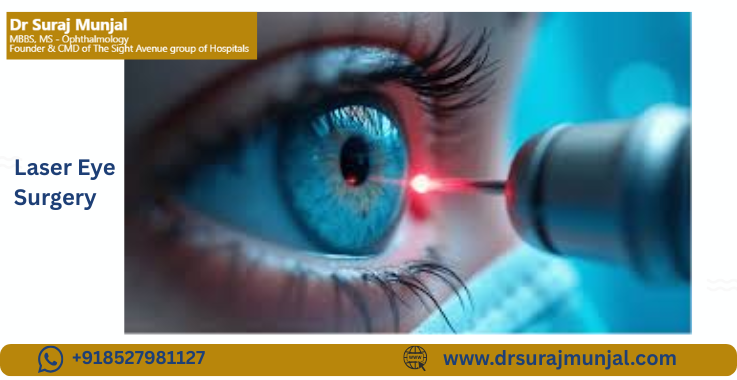
Dr. Suraj Munjal is a renowned ophthalmologist specializing in advanced laser eye surgery techniques. With years of experience and a commitment to patient care, he has helped countless individuals achieve clearer vision and enhanced quality of life. Dr. Munjal employs state-of-the-art technology and evidence-based practices to ensure optimal results for his patients.
Table of Contents
Causes of Vision Problems
Vision problems can arise due to various factors, including:
- Genetics: Family history of vision issues can increase the likelihood of developing similar conditions.
- Age: As we age, the eye’s ability to focus decreases, leading to conditions like presbyopia.
- Environmental Factors: Prolonged exposure to screens, UV light, and poor lighting can contribute to eye strain and deterioration.
- Health Conditions: Conditions like diabetes and hypertension can affect vision.
Types of Laser Eye Surgery
Dr. Suraj Munjal offers several types of laser eye surgeries, including:
-
LASIK (Laser-Assisted In Situ Keratomileusis): LASIK is a popular procedure that reshapes the cornea to improve visual acuity. It involves creating a flap in the cornea, which is lifted to allow the laser to reshape the underlying tissue.
-
PRK (Photorefractive Keratectomy): PRK is an alternative to LASIK, suitable for patients with thinner corneas. Instead of creating a flap, the outer layer of the cornea is removed before reshaping.
-
SMILE (Small Incision Lenticule Extraction): SMILE is a minimally invasive procedure that involves removing a small piece of corneal tissue to correct refractive errors, resulting in less discomfort and faster recovery.
Symptoms Indicating Vision Problems
Patients may experience various symptoms that indicate a need for laser eye surgery, including:
- Blurry or distorted vision
- Difficulty seeing at night
- Frequent changes in prescription glasses or contacts
- Eye strain and fatigue
- Halos around lights
Diagnosis of Vision Problems
To determine the suitability of laser eye surgery, Dr. Munjal conducts a comprehensive eye examination, which includes:
- Visual Acuity Test: Measures the clarity of vision.
- Refraction Test: Determines the appropriate prescription for glasses or contact lenses.
- Corneal Topography: Maps the curvature of the cornea to identify irregularities.
- Pupil Dilation: Allows for a thorough examination of the internal structures of the eye.
Treatment Process
The laser eye surgery process typically involves the following steps:
- Consultation: A detailed discussion about the patient’s medical history, expectations, and potential risks.
- Pre-Operative Tests: Comprehensive eye exams to ensure candidacy for surgery.
- Procedure: Performed in a comfortable and sterile environment, the procedure lasts about 15-30 minutes per eye.
- Post-Operative Care: Instructions for recovery, including follow-up visits to monitor healing and visual outcomes.
Cost of Treatment and Stay in India
India is known for offering world-class medical treatments at affordable prices. The cost of treatment for dry eye syndrome using artificial tears or advanced therapies can vary based on the type of treatment required.
- Artificial Tear Eye Drops: Starting from $10 to $50 (₹800 to ₹4000)
- Punctal Plugs: Between $150 and $400 (₹12,000 to ₹32,000)
- LipiFlow Treatment: Around $800 to $2,000 (₹65,000 to ₹1,60,000)
Stay in India
Patients visiting India for treatment can enjoy a comfortable stay at affordable costs. Depending on the city and type of accommodation, you can expect to pay anywhere from $20 to $150 per night (₹1,500 to ₹12,000).
Frequently Asked Questions
Yes, laser eye surgery is considered safe, with high success rates and minimal complications when performed by a qualified surgeon like Dr. Suraj Munjal.
The surgery usually takes about 15-30 minutes per eye.
Most patients experience improved vision within a few days, although full recovery may take a few weeks.
