Contoura Vision Eye Surgery Cost in India
The cost of Contoura Vision surgery in India ranges from ₹45,000 to ₹60,000 per eye, depending on the hospital, city, and surgeon’s experience. For both eyes, the total cost falls between ₹90,000 and ₹1,20,000, which is approximately $1,100 to $1,400. It includes pre-surgery diagnostics, the procedure, and post-surgical follow-up.
Despite being a premium laser eye procedure, Contoura Vision is significantly more affordable in India than in other countries. Patients receive the same US FDA-approved technology, experienced surgeons, and advanced eye mapping at less than half the price compared to the US or UK.
Hospitals in cities like Delhi, Mumbai, and Bangalore offer dedicated Contoura Vision packages for both local and international patients. These packages typically include all necessary tests, customised vision correction using topography-guided lasers, medications, and short-term follow-up care.
Table of Contents
What Is Contoura Vision?
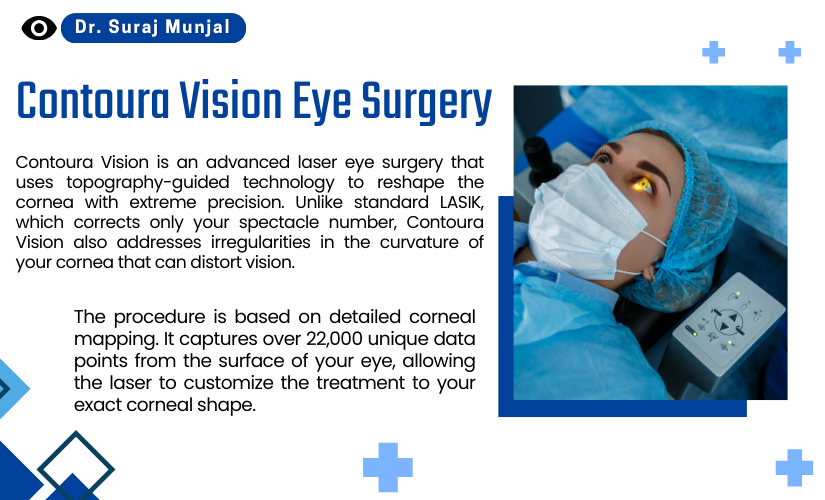
Contoura Vision is an advanced laser eye surgery that uses topography-guided technology to reshape the cornea with extreme precision. Unlike standard LASIK, which corrects only your spectacle number, Contoura Vision also addresses irregularities in the curvature of your cornea that can distort vision.
The procedure is based on detailed corneal mapping. It captures over 22,000 unique data points from the surface of your eye, allowing the laser to customize the treatment to your exact corneal shape. It results in sharper, more natural vision and fewer post-surgery visual disturbances like halos, glare, or poor night vision.
Contoura Vision is particularly effective for patients with irregular corneas, high astigmatism, or who were previously not ideal candidates for LASIK. It is also approved by the US FDA and widely regarded as one of the most precise vision correction options available today.
Because it goes beyond standard number correction and treats both the optical and anatomical aspects of your vision, Contoura Vision is often referred to as “Personalized LASIK” or “Blade-Free Super LASIK.”
Who Is Eligible for Contoura Vision Surgery?
Contoura Vision is suitable for individuals who want precise, spectacle-free vision correction. However, not everyone qualifies. A detailed eye evaluation is necessary to confirm eligibility, as the procedure relies on corneal topography and surface regularity.
- Patients between the ages of 18 and 40 with a stable prescription for at least one year are generally considered.
- The ideal candidate should have a refractive error within the correctable range, typically up to -8.00 diopters of myopia and 3.00 diopters of astigmatism.
- Unlike standard LASIK, Contoura Vision is particularly beneficial for patients with irregular astigmatism, distorted corneal surfaces, or higher-order aberrations. These individuals often do not respond well to conventional laser techniques, but Contoura can offer sharper and more balanced vision.
- The patient must have adequate corneal thickness, as the procedure involves reshaping the cornea. People with extremely thin corneas or advanced dry eye syndrome may not be eligible.
Patients who have previously undergone LASIK or PRK may or may not qualify for Contoura, depending on corneal integrity. A topography-guided scan will determine whether enhancement through Contoura is possible. Those with eye diseases such as keratoconus, uncontrolled diabetes, or active infections are also excluded from this treatment.
What are the Benefits of Contoura Vision Over Other Laser Procedures?
Contoura Vision is an advanced form of LASIK surgery, but its results are more precise and personalized. It offers distinct advantages when compared to traditional LASIK and SMILE surgery, especially for patients who want sharper visual quality and minimal side effects.
- Corrects More Than Just Glasses Power: Standard LASIK and SMILE correct the optical prescription (your sphere and cylinder), but they don’t address microscopic surface imperfections of the cornea. Contoura Vision does. It treats irregularities in the corneal curvature by using topography-guided data, leading to more accurate correction.
- Higher Visual Quality: Patients often report better contrast sensitivity and clarity with Contoura Vision, especially in low-light conditions. It significantly reduces common post-LASIK issues like glare, halos, and poor night vision that may persist with older techniques.
- Personalized Eye Mapping: Contoura Vision uses a custom corneal map based on over 22,000 elevation points, tailoring the laser treatment to your eye anatomy. This level of customization is not available in SMILE or basic LASIK, making Contoura more refined and precise.
- Ideal for Complex Corneas: Contoura is especially beneficial for patients with irregular astigmatism, corneal asymmetry, or surface distortions. These patients may not be good candidates for SMILE or standard LASIK, but Contoura offers them a viable, safe alternative with better outcomes.
- Blade-Free and Safe: Like Femto-LASIK, Contoura Vision is completely bladeless. The flap is created with a femtosecond laser, not a blade, ensuring precision and safety during surgery.
How Is Contoura Vision Surgery Performed?
Contoura Vision surgery begins with a detailed pre-operative eye evaluation. The surgeon performs a corneal topography scan using a device called the Topolyzer Vario, which maps over 22,000 elevation points on the corneal surface. This scan identifies even the most minor irregularities in shape and curvature that affect visual quality.
Once your eligibility is confirmed, the hospital schedules the procedure. On the day of surgery, the medical team applies numbing eye drops. You remain fully awake, but the eye feels no pain. A speculum holds the eyelids open to prevent blinking during the procedure.
The surgeon then uses a femtosecond laser to create a thin corneal flap. This bladeless technique ensures accuracy and safety. After lifting the flap, an excimer laser reshapes the cornea based on your unique topography data. Unlike standard LASIK, which treats only the optical zone, Contoura treats both optical and anatomical imperfections for more refined vision.
Once the laser completes the reshaping, the surgeon repositions the flap. The eye starts healing immediately without stitches. The entire surgery takes 15 to 20 minutes for both eyes, and you leave the hospital the same day.
Most patients start noticing improved vision within a few hours. However, complete visual clarity usually sets in over 1 to 3 days, depending on individual healing speed.
What is the Cost of Contoura Vision Eye Surgery in India?
The cost of Contoura Vision surgery in India typically ranges from ₹45,000 to ₹60,000 per eye, depending on the city, hospital, and surgeon. For both eyes, the total cost usually falls between ₹90,000 and ₹1,20,000. For international patients, this equals approximately $1,100 to $1,400.
This pricing reflects the use of US FDA-approved technology, highly detailed corneal mapping, and surgeon expertise. Compared to other premium refractive procedures, Contoura Vision offers superior visual quality at a relatively affordable price.
Hospitals in metro cities like Delhi, Mumbai, Bangalore, and Chennai offer competitively priced packages that include consultation, diagnostics, surgery, medications, and follow-up. While the pricing may be slightly higher at branded eye centers or with senior surgeons, the outcomes often justify the difference.
|
Contoura Vision Type |
Cost (Per Eye) |
Cost (Both Eyes) |
Approx. USD (Both Eyes) |
|
Topography-Guided LASIK |
₹45,000 – ₹60,000 |
₹90,000 – ₹1,20,000 |
$1,100 – $1,400 |
This pricing remains far more affordable than in most Western countries while offering equal or better technology and results.
What’s Included in the Cost Package?
Hospitals in India offering Contoura Vision surgery usually provide all-inclusive packages that cover every essential component of the procedure. These packages ensure there are no hidden costs and allow patients, especially those traveling from abroad, to plan their treatment with complete transparency.
- The cost package typically includes a detailed pre-operative diagnostic session, which involves refraction checks, corneal topography, pachymetry, and dry eye evaluation. These tests determine eligibility and provide the laser system with the exact corneal data needed for custom correction.
- The surgeon consultation is also included. During this session, you receive a detailed explanation of your eye scan results, treatment plan, and expected outcomes.
- The surgery itself includes the use of a femtosecond laser for flap creation and an excimer laser for topography-guided correction. All charges related to the laser machines, surgical instruments, disposables, and staff support are bundled into the total cost.
- Post-surgery, the package covers medications such as antibiotic drops, lubricating eye drops, and protective gear like eye shields or sunglasses. Most hospitals also offer at least two follow-up visits to monitor healing and ensure the corneal flap is settling properly.
- For international patients, some hospitals offer optional services like airport transfers, hotel booking assistance, and interpreter support, which can be added at an additional but transparent cost.
In short, the package includes:
- Complete diagnostics
- Surgeon consultation
- Contoura Vision procedure using FDA-approved tech
- Medications and post-op care
- Follow-up visits for 1–2 weeks after surgery
Contoura Vision Cost Breakdown in India
The total cost of Contoura Vision surgery in India usually falls between ₹90,000 to ₹1,20,000 for both eyes.
- The pre-operative tests typically cost between ₹5,000 and ₹7,000. Surgeon consultation charges usually range from ₹1,000 to ₹2,000. Some hospitals adjust this fee into the final surgical package if the patient proceeds with the treatment.
- The core of the cost lies in the laser surgery. Contoura Vision surgery costs ₹45,000 to ₹60,000 per eye, depending on the surgeon's experience, hospital reputation, and city of treatment. It includes the use of advanced laser platforms like Alcon Wavelight EX500 and Topolyzer Vario.
- After the surgery, patients are prescribed medicated eye drops and lubricants, which cost an additional ₹2,000 to ₹3,000. Follow-up visits (usually 1 to 2) are included in the surgery package at most hospitals.
- For international patients, optional services such as airport transfers, hotel arrangements, and interpreter assistance may come at an additional charge.
|
Cost Component |
Estimated Price (INR) |
Estimated Price (USD) |
|
Pre-operative Diagnostics & Eye Mapping |
₹5,000 – ₹7,000 |
$60 – $85 |
|
Surgeon Consultation |
₹1,000 – ₹2,000 |
$12 – $25 |
|
Contoura Vision Surgery (Per Eye) |
₹45,000 – ₹60,000 |
$550 – $700 |
|
Contoura Vision Surgery (Both Eyes) |
₹90,000 – ₹1,20,000 |
$1,100 – $1,400 |
|
Post-op Medications & Protective Gear |
₹2,000 – ₹3,000 |
$25 – $35 |
|
Follow-up Visits (1–2 sessions) |
Usually Included |
Usually Included |
Cost Comparison with Other Countries
Contoura Vision surgery in India offers a significant cost advantage compared to most developed countries, while maintaining equal standards of safety, technology, and outcomes. Patients receive topography-guided LASIK using FDA-approved equipment at a fraction of what they would pay elsewhere.
Even after including travel and short-term accommodation, international patients often save 50% to 70% on their total treatment expenses by choosing India.
|
Country |
Approximate Cost (Both Eyes) |
|
India |
$1,100 – $1,400 |
|
United States |
$3,000 – $5,000 |
|
United Kingdom |
$3,200 – $4,500 |
|
UAE |
$2,500 – $3,800 |
|
Thailand |
$1,800 – $2,700 |
|
Australia |
$3,000 – $4,200 |
What are the Factors That Affect the Cost in India?
The cost of Contoura Vision surgery in India varies for every patient. It depends on several variables, both medical and logistical, that can influence the final amount.
- Type of Technology Used: Hospitals using the latest Alcon Wavelight EX500 platform combined with Topolyzer Vario scans may charge slightly more. This system is FDA-approved and delivers high precision, which adds to the overall value and price.
- Surgeon’s Experience: Highly experienced surgeons, especially those with thousands of successful laser eye surgeries, often charge a premium. Their expertise, however, leads to safer procedures and better visual outcomes, justifying the cost difference.
- Hospital Location: Centers in metro cities like Delhi, Mumbai, or Bangalore typically have higher costs due to modern infrastructure and higher overheads. Clinics in smaller cities may offer lower prices but could have fewer advanced resources.
- Additional Pre-Existing Conditions: Patients with issues like dry eyes, corneal irregularities, or previous laser surgeries may require further diagnostics or customized treatment planning, which can slightly increase the package cost.
- Inclusions and Optional Add-ons: Some hospitals offer packages with post-op kits, longer follow-up schedules, or value-added services for international patients, including interpreters and airport transfers. These extras can raise the overall cost.
Why Choose India for Contoura Vision Surgery?
India has become one of the most preferred destinations for advanced laser vision correction, including Contoura Vision. Patients from around the world choose India not only for affordability but also for the high standards of medical care and advanced technology available at top eye hospitals.
Indian ophthalmic centers use FDA-approved Contoura Vision platforms like Alcon Wavelight EX500 and Topolyzer Vario, the same systems used in the US. and Europe. These hospitals maintain strict hygiene, surgical safety, and diagnostic accuracy. Many surgeons in India are internationally trained and have performed over 10,000 successful laser procedures, offering deep expertise in corneal correction and visual enhancement.
Patients benefit from quick scheduling, short waiting periods, and same-day surgery planning. Unlike countries where you might wait weeks for consultation and surgery, Indian hospitals deliver fast and well-organized treatment timelines—ideal for international travelers.
With costs 60%–70% lower than Western countries, India provides the same global-standard outcomes at a much more accessible price point. The cost advantage becomes even more valuable when paired with the quality of surgical care and long-term visual outcomes.
International Patient Services
Top hospitals in India offer end-to-end support services for international patients undergoing Contoura Vision surgery. These services are designed to make the experience stress-free from arrival to post-surgery recovery.
- Hospitals begin by assisting with medical visa documentation, including invitation letters and scheduling confirmations. Once travel is arranged, patients are offered airport pickup services to ensure a smooth transfer to their hotel or hospital. Some hospitals also help with nearby budget accommodation bookings, depending on the patient’s needs.
- Upon arrival, each patient is assigned a dedicated international coordinator. This person assists throughout the stay—managing appointments, explaining test results, and providing guidance in multiple languages if needed. Hospitals with international wings often offer Arabic, French, Russian, Bengali, or Swahili translators, ensuring smooth communication.
- Many centers offer pre-arrival consultations by reviewing eye test reports over email or WhatsApp. It helps patients receive a tentative confirmation of eligibility before traveling, saving time during the stay.
- After surgery, hospitals continue to support international patients with teleconsultations, post-op care instructions, and recovery monitoring even after they return home. Surgeons remain accessible via messaging or video calls to answer questions and provide medical advice during the healing period.
Success Rate and Patient Outcomes for Contoura Vision Surgery in India
Contoura Vision has one of the highest success rates among modern laser vision correction procedures. In India, hospitals using FDA-approved platforms like Alcon Wavelight EX500 consistently report visual success rates above 98% for eligible candidates. These results are not limited to spectacle power correction but extend to overall visual sharpness and quality.
Most patients achieve 6/6 or 20/20 vision or better within the first week. Unlike standard LASIK, Contoura Vision also reduces higher-order aberrations—the tiny surface irregularities that impact night vision, contrast, and clarity. It leads to better visual outcomes even in low-light environments.
The treatment is also known to produce fewer side effects, with many patients reporting reduced halos, glare, and starbursts. It is especially beneficial for those with irregular corneas or asymmetric astigmatism, who do not respond well to basic LASIK or SMILE procedures.
Indian surgeons trained in Contoura Vision protocols follow strict topography-based eligibility screening, which ensures the procedure is only performed on suitable candidates.
Clinical data from Indian centers show that most patients experience:
- Stable vision within 3 to 7 days
- Improved contrast sensitivity
- High satisfaction levels after 1 month
- No significant vision regression even after 1–2 years
The precision of the laser, accuracy of corneal mapping, and skill of the surgeon all contribute to Contoura’s reputation as a next-generation refractive surgery that delivers lasting results and superior patient satisfaction.
Recovery Timeline and Aftercare
Recovery after Contoura Vision surgery is quick and uncomplicated. Most patients begin to notice improvement within just a few hours, and functional vision typically stabilizes within the first 3 to 5 days. Because the procedure is bladeless and highly precise, the healing process is smoother compared to older laser techniques.
On the day of surgery, the patient may experience mild irritation, watering, or sensitivity to light. These symptoms usually resolve by the next morning. Vision may appear slightly hazy initially, but clarity improves rapidly as the corneal flap begins to settle.
By Day 2 or 3, patients often resume reading, using digital screens, and light indoor activities without discomfort.
By the end of the first week, most people return to work or regular daily routines, including driving and office tasks.
Full visual sharpness, especially in challenging conditions like dim lighting or night driving, continues to improve over the next 2 to 3 weeks as the eyes fully adapt to the new corneal shape.
Aftercare Instructions
Patients are prescribed antibiotic and anti-inflammatory eye drops for around 2 to 3 weeks to prevent infection and control inflammation. Lubricating drops are also recommended to reduce temporary dryness, which is common after laser procedures.
Doctors advise patients to avoid touching or rubbing the eyes for at least one week. Protective shields or sunglasses are often provided to wear outdoors or while sleeping, especially during the first few nights. Swimming, eye makeup, and heavy exercise should be avoided for at least 10 to 14 days.
Follow-up visits are scheduled on Day 1, and again around Week 1 or 2, depending on individual healing. These appointments help the surgeon monitor flap integrity, tear film stability, and visual improvement.
Travel and Return to Home Country
For international patients, it is safe to travel 3 to 5 days after surgery, provided the first follow-up visit is completed and the healing is on track. Hospitals in India often offer teleconsultation support for any follow-up needs after returning home.
Patient Testimonials
“I couldn’t believe the clarity.”
— Youssef M., Cairo, Egypt
“I had high astigmatism and was told I wasn't eligible for standard LASIK. In Delhi, the surgeon recommended Contoura Vision. The entire process took just two days. My vision is now crystal clear, even at night. The cost was a third of what I was quoted back home.”
“Better than I expected.”
— Sarah K., London, UK
“I came to India for Contoura after reading about its accuracy. The hospital arranged everything—pickup, hotel, consultation. The procedure was painless, and I returned to work in a week. My night vision has improved dramatically. The results exceeded my expectations.”
“Professional, affordable, and fast.”
— Adeel R., Dubai, UAE
“I didn’t want to wait months for surgery. India offered the same laser technology and trained doctors, but at a much lower cost. The staff spoke fluent Arabic, the hospital was spotless, and the follow-up support continued even after I flew back.”
Frequently Asked Questions
Contoura Vision surgery typically costs between ₹45,000 to ₹60,000 per eye, or ₹90,000 to ₹1,20,000 for both eyes. In USD, that’s around $1,100 to $1,400, depending on the hospital, surgeon, and location.
Most packages include pre-surgery diagnostics, corneal mapping, surgeon consultation, the laser procedure, post-operative medications, and follow-up visits. Some hospitals also offer optional services like airport pickup and hotel stay for international patients.
Yes. Contoura Vision uses topography-guided mapping to treat both your spectacle number and corneal surface irregularities. It offers sharper vision, fewer side effects, and better night-time clarity than basic LASIK.
Yes, in most cases, both eyes are treated in a single sitting. The entire procedure takes about 15–20 minutes for both eyes, and patients go home the same day.
International patients are usually cleared to fly 3 to 5 days after surgery, depending on their healing and the doctor's approval. One follow-up is generally required before departure.
Most patients achieve 6/6 or 20/20 vision and do not need glasses for distance vision. If you are over 40, you may still need reading glasses unless you opt for monovision planning.
No. Reputed hospitals in India provide transparent, upfront pricing. Always ask for a written cost estimate, which should include diagnostics, surgery, drops, and follow-ups.
No. The procedure is performed under numbing eye drops and is entirely painless. You may feel slight irritation for a few hours afterward, which subsides quickly.
