Astigmatism Treatment Cost in India
Astigmatism is a common yet often misunderstood vision condition that causes blurry or distorted vision due to the irregular shape of the cornea or lens. Fortunately, with modern advancements in refractive eye surgery, astigmatism can now be corrected permanently using safe, minimally invasive techniques, such as LASIK, PRK, or implantable contact lenses (ICL). These procedures provide long-lasting visual clarity, eliminating the need for glasses or contact lenses.
For patients seeking affordable yet world-class treatment options, India has emerged as a global leader in astigmatism correction. Equipped with cutting-edge ophthalmic technology, internationally trained surgeons, and JCI- and NABH-accredited eye hospitals, India offers premium quality care at a fraction of the cost found in Western nations.
As of today, the average cost of astigmatism treatment in India ranges from ₹30,000 to ₹1,10,000, which is approximately $350 to $1,300, depending on the specific procedure selected and the severity of your refractive error. Compared to the United States or the UK, where LASIK and similar surgeries can cost between $2,500 and $4,500 per eye, India offers a cost-effective alternative that does not compromise on quality or safety.
Patients from countries such as the UAE, Kenya, Bangladesh, Nepal, the UK, and the USA travel to India to undergo laser eye surgeries under the guidance of renowned ophthalmic experts, including Dr. Suraj Munjal, Founder and Chief Surgeon at The Sight Avenue – one of India’s leading super-speciality eye hospitals.
Table of Contents
What Is Astigmatism?
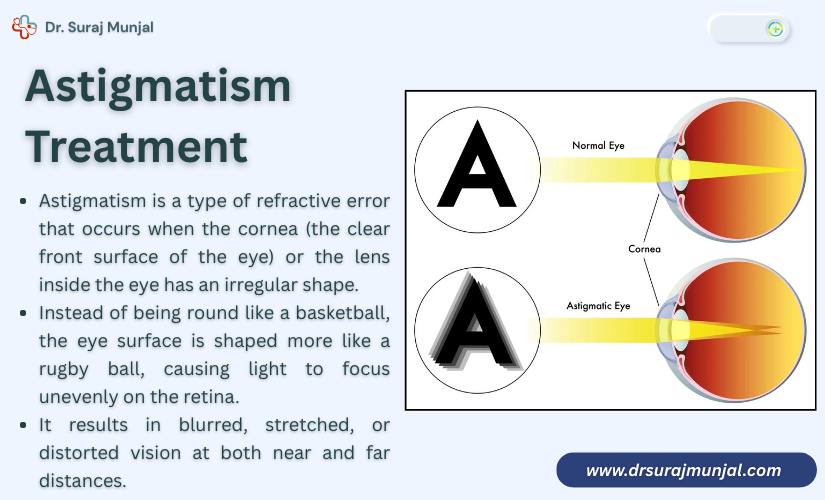
Astigmatism is a type of refractive error that occurs when the cornea (the clear front surface of the eye) or the lens inside the eye has an irregular shape. Instead of being round like a basketball, the eye surface is shaped more like a rugby ball, causing light to focus unevenly on the retina. It results in blurred, stretched, or distorted vision at both near and far distances.
In a normal eye, the cornea and lens work together to bend (refract) incoming light, focusing it precisely on the retina at the back of the eye. When there is astigmatism, this refraction becomes uneven due to the asymmetry of the eye’s curvature. As a result, instead of focusing on a single point, light scatters, creating visual disturbances.
Astigmatism is often present from birth and can exist alongside other refractive errors, like:
- Myopia (nearsightedness)
- Hyperopia (farsightedness)
It’s not a disease or a health threat, but it can significantly affect your quality of life, causing:
- Eyestrain and fatigue
- Headaches
- Poor night vision
- Difficulty seeing fine details
Common symptoms of astigmatism include:
- Blurred or fuzzy vision at all distances
- Squinting to see clearly
- Double vision in one eye
- Glare or halos around lights
- Difficulty seeing at night
What are the Treatment Options for Astigmatism?
Treatment depends on the severity of the condition and patient preferences. The most common and effective treatment methods include:
Eyeglasses and Contact Lenses as Non-Surgical Options
For many people, the first line of treatment for astigmatism involves prescription eyeglasses. These glasses use specially designed cylindrical lenses to compensate for the uneven shape of the cornea. They are easy to use, widely available, and cost-effective, but they only offer temporary correction.
Another non-surgical option is the use of toric contact lenses. These lenses are specifically shaped to fit the unique curvature of an eye with astigmatism. Toric lenses offer improved peripheral vision compared to glasses and are a popular choice for active individuals. However, they may cause dryness or discomfort over time and must be replaced regularly.
While both methods improve vision, they do not cure the condition. Patients seeking a more permanent solution often consider refractive surgery.
LASIK Surgery for Astigmatism Correction
LASIK, or Laser-Assisted In Situ Keratomileusis, is one of the most commonly performed procedures for correcting mild to moderate astigmatism. The surgery uses a laser to reshape the cornea, allowing light to focus correctly on the retina. LASIK is a fast, painless procedure that typically takes less than 15 minutes per eye, and most patients resume normal activities within 24 to 48 hours.
This procedure is suitable for people with stable vision, adequate corneal thickness, and no other major eye conditions. LASIK provides excellent results, with most patients achieving 20/20 vision or better after a full recovery.
PRK Surgery for Patients with Thin Corneas
Photorefractive Keratectomy, or PRK, is another type of laser eye surgery used to treat astigmatism. Unlike LASIK, PRK does not involve creating a flap in the cornea. Instead, the outer layer of the cornea is gently removed, and the underlying tissue is reshaped with a laser.
PRK is especially beneficial for patients with thin corneas or those who are not ideal candidates for LASIK. Although the recovery time is slightly longer and involves more initial discomfort, the long-term visual outcomes are similar to those of LASIK.
ICL Surgery for High Astigmatism or Thin Corneas
For patients who are not eligible for laser eye surgery, implantable collamer lens (ICL) implantation is a highly effective alternative. ICL involves placing a customized artificial lens inside the eye, behind the iris, and in front of the natural lens. This lens corrects astigmatism by properly focusing light on the retina.
ICL surgery is suitable for patients with high degrees of astigmatism or those with very thin corneas that cannot undergo LASIK or PRK safely. One of the major advantages of ICL is that it is reversible—if necessary, the lens can be removed or replaced in the future.
Toric Intraocular Lenses for Patients with Cataracts
In patients who have both cataracts and astigmatism, toric intraocular lenses (IOLs) can be implanted during cataract surgery. These lenses are specially designed to correct both conditions in a single procedure. By replacing the clouded natural lens with a toric IOL, patients can achieve clearer, sharper vision without relying heavily on glasses after surgery.
Toric IOLs are an excellent option for older adults or those already planning cataract surgery, offering long-term vision correction tailored to individual refractive needs.
What is the Cost of Astigmatism Treatment in India?
The cost of treating astigmatism in India is significantly lower than in many Western countries, making it an attractive destination for patients seeking affordable, high-quality eye care. As of 2025, the average cost of astigmatism correction in India ranges between ₹30,000 and ₹1,10,000, which equals approximately $350 to $1,300, depending on the type of procedure chosen, the hospital’s location, and the technology used.
This broad price range reflects the various types of treatments available, ranging from standard LASIK surgery to more advanced procedures, such as ICL implantation or customized wavefront-guided laser corrections. While LASIK tends to fall at the lower end of the spectrum, procedures such as ICL or Toric lens implants are typically more expensive due to the use of imported intraocular lenses and the complexity of the surgical steps involved.
What Is Included in the Treatment Cost?
Most hospitals and eye centers in India offer comprehensive packages that cover several essential components of the treatment. A typical astigmatism correction package in India includes:
- Initial consultation and eye evaluation: A full diagnostic assessment including corneal topography, pachymetry, and refractive error measurement.
- Surgical procedure cost: This includes the cost of laser or implantable lens technology, operating theater charges, surgeon’s fees, and equipment charges.
- Medications and eye drops: Post-operative medications, antibiotics, lubricating eye drops, and anti-inflammatory eye drops are necessary for proper healing.
- Post-surgery follow-up visits: Most packages include at least 1 to 3 follow-up consultations to monitor healing and visual outcome.
- Protective eyewear and support items: In some cases, protective glasses or eye shields are provided for use during the recovery phase.
Some high-end hospitals may also include teleconsultation support, priority appointments, and personal care coordinators for international patients.
Exclusions to Keep in Mind
Although packages are usually inclusive, certain items might not be covered unless specified:
- Additional diagnostic scans are not part of the standard protocol.
- Retreatment or enhancement surgery (if needed later)
- Hotel accommodation or airport transfers for medical tourists
- Long-term eye care in case of residual astigmatism
Patients are advised to request a written quotation from the hospital in advance and confirm all inclusions to avoid surprise expenses later.
Cost Breakdown of Astigmatism Treatment in India
Astigmatism treatment in India is available through several procedures, each with its own price range depending on the technique used, the surgeon’s expertise, and the technology involved. Below is a detailed cost breakdown to help you understand how your total expense is calculated when opting for astigmatism correction in India.
Initial Consultation and Diagnostic Tests
Before any treatment begins, patients undergo a comprehensive eye examination. This includes corneal topography, refraction tests, pachymetry (a measurement of corneal thickness), and slit-lamp evaluation.
Cost Range: ₹1,000 – ₹3,000 ($12 – $35)
LASIK Surgery (Conventional or Wavefront-Guided)
LASIK is one of the most common and cost-effective options for correcting mild to moderate astigmatism. Pricing may vary depending on whether standard, blade-free, or customized laser technology is used.
Cost Range (Per Eye): ₹35,000 – ₹60,000 ($420 – $720)
PRK Surgery (Photorefractive Keratectomy)
PRK is typically chosen by patients with thin corneas or those unsuitable for LASIK. Though less expensive than some advanced procedures, PRK has a slightly longer healing time.
Cost Range (Per Eye): ₹30,000 – ₹55,000 ($360 – $660)
ICL (Implantable Collamer Lens) Surgery
ICL is ideal for patients with high astigmatism or those not eligible for laser surgeries. The procedure involves implanting a biocompatible lens inside the eye. The cost is higher due to the import of specialized lenses and the complexity of the surgery.
Cost Range (Per Eye): ₹80,000 – ₹1,10,000 ($950 – $1,300)
Toric IOL Implant (For Cataract Patients)
For patients undergoing cataract surgery, toric intraocular lenses can correct astigmatism simultaneously. The cost depends on the type and brand of the IOL selected.
Cost Range: ₹45,000 – ₹85,000 ($540 – $1,020)
Post-Surgery Medications and Eye Drops
After the procedure, patients are prescribed eye drops to prevent infection, control inflammation, and maintain lubrication.
Cost Range: ₹1,500 – ₹3,000 ($18 – $36)
Follow-Up Visits and Monitoring
Most hospitals include 1–3 post-operative checkups in the treatment package. Additional visits may be chargeable separately.
Cost Range: ₹500 – ₹1,000 per visit ($6 – $12)
Total Estimated Package Cost (All-Inclusive)
For international patients, a full package that includes diagnostics, surgery, post-op care, and follow-ups typically falls within ₹30,000 – ₹1,10,000 INR ($350 – $1,300). It makes India one of the most cost-effective destinations globally for permanent astigmatism correction, without compromising on safety or clinical outcomes.
Astigmatism Treatment Cost Breakdown in India (2025)
|
Service / Procedure |
Estimated Cost (INR) |
Estimated Cost (USD) |
Remarks |
|
Initial Consultation & Diagnostics |
₹1,000 – ₹3,000 |
$12 – $35 |
Includes eye mapping, refraction, and topography |
|
LASIK Surgery (Standard/Wavefront) |
₹35,000 – ₹60,000 |
$420 – $720 |
Cost per eye varies by technology used |
|
PRK Surgery |
₹30,000 – ₹55,000 |
$360 – $660 |
Suitable for thin corneas |
|
ICL Surgery (Implantable Lens) |
₹80,000 – ₹1,10,000 |
$950 – $1,300 |
Ideal for high astigmatism or thin corneas |
|
Toric Intraocular Lens (IOL) Implant |
₹45,000 – ₹85,000 |
$540 – $1,020 |
Usually done during cataract surgery |
|
Post-Surgery Medications & Eye Drops |
₹1,500 – ₹3,000 |
$18 – $36 |
Includes antibiotic, anti-inflammatory, and lubricating drops |
|
Follow-Up Consultations |
₹500 – ₹1,000 per visit |
$6 – $12 per visit |
1–3 visits are included in the package |
|
Total Estimated Treatment Package |
₹35,000 – ₹1,10,000 |
$420 – $1,300 |
May include diagnostics, surgery, meds, and follow-up |
Cost Comparison: India vs Other Countries
India has established itself as a global hub for high-quality, affordable eye care, particularly for refractive procedures such as astigmatism correction. Patients from the United States, Europe, the Middle East, Africa, and Southeast Asia routinely travel to India not just for the affordability, but also for access to advanced laser systems, internationally trained surgeons, and personalized care.
To better understand the value proposition, here’s how astigmatism treatment costs in India compare with those in other countries:
|
Country |
Average Cost (USD) |
Typical Inclusions |
Remarks |
|
India |
$350 – $1,300 |
Consultation, diagnostics, LASIK/PRK/ICL, meds, follow-ups |
Most hospitals offer bundled packages with no hidden costs |
|
United States |
$2,500 – $4,500 |
LASIK only; extra charges for consultation and aftercare |
Not usually covered by insurance; expensive for self-paying |
|
United Kingdom |
$2,000 – $3,800 |
LASIK or PRK; follow-ups may cost extra |
Limited NHS coverage; long wait times in public healthcare |
|
Singapore |
$2,200 – $4,000 |
LASIK; excludes ICL and premium laser platforms |
High-quality care but priced at a premium |
|
Thailand |
$1,500 – $2,500 |
LASIK or PRK; basic post-op care included |
More expensive than India |
|
UAE |
$2,200 – $3,500 |
LASIK or ICL; follow-up and diagnostics are often excluded |
Quality comparable to India, but costs are significantly higher |
Why Is India More Affordable?
There are several reasons why astigmatism correction is more economical in India:
- Lower operating and infrastructure costs, even in high-end hospitals.
- No compromise on technology—hospitals like The Sight Avenue use FDA-approved machines and globally recognized techniques.
- Surgeon fees are lower, despite many Indian eye surgeons having international fellowships and certifications.
- Currency exchange benefits are available for foreign patients, especially those from the US, UK, Australia, or Europe.
What are the Factors Affecting Astigmatism Treatment Cost in India?
While India offers some of the most affordable astigmatism correction treatments in the world, the total cost you’ll pay can still vary significantly based on several influencing factors. Understanding these elements can help you plan your budget more effectively and select the most suitable treatment option for your needs.
Type of Procedure Chosen
The cost of astigmatism correction primarily depends on the surgical method selected. LASIK is generally the most economical option, while advanced procedures like ICL (Implantable Collamer Lens) or Toric IOL implantation cost significantly more due to the use of specialized lenses and complex techniques. PRK falls within a similar range to LASIK but may be recommended in specific clinical cases, such as thin corneas or dry eyes. Each procedure has different equipment requirements and involves varying levels of surgical expertise, which is reflected in the final price.
Technology and Equipment Used
Modern eye hospitals in India offer various types of laser platforms, including femtosecond lasers (blade-free LASIK), wavefront-guided LASIK, and topography-guided systems. These technologies provide more customized and precise treatments, but they come at a higher price. Hospitals equipped with the latest FDA-approved systems may charge more for access to premium-level care, though the improved accuracy often justifies the additional cost.
City and Hospital Tier
The location of the hospital also plays a role in determining the treatment cost. Eye care centers in metro cities like Delhi, Mumbai, or Bangalore may have slightly higher pricing compared to hospitals in smaller cities or towns. However, these facilities often offer advanced infrastructure, international accreditations (like JCI or NABH), and a dedicated international patient support system.
Tier-1 eye hospitals, such as The Sight Avenue in New Delhi, offer world-class care that may be slightly more expensive than local clinics, but with enhanced outcomes and patient safety.
Surgeon’s Expertise and Reputation
Experienced ophthalmic surgeons who specialize in refractive surgery often charge higher consultation and surgical fees. However, their precision and expertise can greatly influence your results. Surgeons like Dr. Suraj Munjal, with international training and thousands of successful cases, may command a premium fee, but patients are assured of high safety standards and excellent visual outcomes.
Severity of Astigmatism and Eye Condition
Patients with mild astigmatism may only require basic LASIK, while those with high or irregular astigmatism may need advanced correction methods, such as Toric ICL or customized ablation profiles. Additionally, if a patient has other eye conditions such as cataracts, dry eye syndrome, or corneal scars, the treatment protocol becomes more complex, leading to increased cost.
One Eye vs. Both Eyes
Many patients choose to treat both eyes simultaneously, which often results in a discounted package rate. However, suppose only one eye is affected or treated. In that case, the cost per eye may be higher because certain procedural and equipment charges remain constant regardless of whether one or two eyes are treated.
Package Inclusions and Add-ons
Some hospitals offer comprehensive packages that include everything from pre-surgical tests to post-operative care, protective eyewear, and follow-up visits. Others may offer a more basic plan with optional add-ons. It's essential to confirm what's included in the quoted price to avoid hidden costs later.
International Patient Support in India
India has become a leading destination for medical tourism, particularly for eye care and vision correction procedures, such as astigmatism treatment. Recognizing the needs of international patients, top hospitals and specialty eye centers across the country have developed robust, patient-friendly support systems to ensure a smooth, stress-free medical journey from arrival to recovery.
- Visa Assistance and Travel Support: Hospitals provide medical invitation letters to help patients secure visas quickly. Coordinators also assist with itinerary planning and guide you through pre-travel requirements.
- Airport Pickup and Local Transportation: International patients receive airport pickup in private vehicles arranged by the hospital. Transportation is also arranged for hospital visits and follow-up appointments.
- Accommodation and Nearby Stay Options: Hospitals partner with hotels near the facility to provide comfortable stays for patients and their families. Options range from budget to luxury, often with recovery-friendly amenities.
- Language Interpretation Services: Multilingual staff and interpreters are available for Arabic, Russian, French, Swahili, Bangla, and more. This ensures clear communication throughout your treatment.
- Personalized Care Coordinators: Each patient is assigned a dedicated coordinator who manages appointments, tests, and billing. They also help with medications and ensure a seamless experience.
- Post-Treatment Virtual Follow-Ups: Hospitals offer teleconsultation after you return home to track your healing. Doctors review your progress and adjust medications or instructions if needed.
- Cultural and Dietary Considerations: Hospitals accommodate cultural needs by offering halal meals, vegetarian options, and separate male/female staff upon request. Prayer spaces are also available.
Why Choose India for Astigmatism Treatment?
India has rapidly gained international recognition as a preferred destination for vision correction procedures, particularly for treating astigmatism. The country offers an exceptional blend of affordability, advanced technology, and medical expertise, making it a top choice for patients seeking permanent solutions to vision problems.
Here are the key reasons why India stands out for astigmatism correction:
Advanced Laser and Lens Technologies
Leading eye hospitals in India are equipped with cutting-edge laser platforms, including femtosecond bladeless LASIK, wavefront-guided LASIK, topography-guided PRK, and customized ablation technology. These systems offer unmatched precision, resulting in sharper vision and faster healing. For patients with high or irregular astigmatism, advanced ICL implants and toric IOLs are available, sourced from top global manufacturers.
Highly Experienced Ophthalmic Surgeons
India is home to some of the most accomplished ophthalmologists in the world. Many have trained and practiced in countries such as the US, UK, or Germany and have extensive experience performing thousands of successful refractive surgeries. Specialists like Dr. Suraj Munjal, Founder and Chief Surgeon of The Sight Avenue, are recognized for achieving high success rates with both laser and lens-based procedures for correcting astigmatism.
Global Standard Facilities
Top eye hospitals in India adhere to international safety protocols and are accredited by reputable organizations, including the Joint Commission International (JCI) and the National Accreditation Board for Hospitals and Healthcare Providers (NABH). These facilities utilize single-use, sterile equipment, air-purified operating theaters, and digital diagnostic labs to ensure a safe and infection-free environment.
Cost-Effective Treatment Without Compromise
India offers high-quality eye care at prices that are significantly more affordable than in Western countries. The low treatment cost does not compromise quality. Instead, it is a result of lower operational costs, government support for medical tourism, and a highly efficient healthcare system. Patients can save up to 70–80% compared to their home country, even after factoring in travel and accommodation costs.
Short Waiting Periods and Personalized Care
Unlike in countries where patients often wait weeks or even months for elective procedures, eye hospitals in India offer fast scheduling, often with next-day consultations and surgery within 48 hours. International patients are assigned dedicated care coordinators who help with hospital appointments, visa letters, airport transfers, and follow-up care.
Multilingual Staff and Support Teams
Language is rarely a barrier in Indian hospitals. English is widely spoken, and many institutions also offer interpretation services for Arabic, French, Swahili, Russian, and other major languages, ensuring a comfortable experience for patients from different regions.
What is the Success Rate of Astigmatism Surgery in India?
One of the most reassuring aspects of undergoing astigmatism treatment in India is the consistently high success rate of both laser and lens-based corrective procedures. Whether you choose LASIK, PRK, or ICL, Indian ophthalmic surgeons deliver world-class outcomes that rival or even exceed those in countries like the US or UK.
LASIK Surgery Success Rate
LASIK is the most commonly performed surgery for correcting mild to moderate astigmatism. In India, the procedure boasts a success rate of over 95%, with the majority of patients achieving 20/20 or near-perfect vision without the need for glasses or contact lenses.
Factors contributing to this high success rate include:
- Use of advanced wavefront-guided or femtosecond laser technology
- Detailed preoperative mapping of the cornea
- High-volume experience of surgeons who have performed thousands of successful LASIK procedures
Moreover, LASIK outcomes in India continue to improve with the adoption of AI-assisted planning systems and robotic alignment tools, ensuring millimeter-precise corrections.
PRK Surgery Success Rate
Photorefractive Keratectomy (PRK) is often recommended for patients with thinner corneas or those who experience dry eyes. In experienced hands, PRK achieves success rates similar to LASIK, typically around 92% to 95% for uncorrected distance vision of 6/6 (20/20).
The recovery process with PRK takes slightly longer, but the long-term vision outcomes remain highly reliable. PRK is also preferred in some military and aviation cases due to the absence of corneal flap creation.
ICL and Toric Lens Implant Success Rate
Patients with high or irregular astigmatism often undergo Implantable Collamer Lens (ICL) surgery or receive Toric IOLs during cataract procedures. These lens-based solutions achieve success rates exceeding 98%, accompanied by extremely high levels of patient satisfaction.
Key benefits of ICL and toric lens procedures include:
- Crisp, high-definition vision
- Reversibility (in case of ICL)
- Suitability for complex or previously untreated refractive errors
- No permanent reshaping of the cornea
Patient Satisfaction and Outcomes
Thousands of international patients travel to India each year for astigmatism correction, reporting life-changing improvements in their vision, confidence, and overall lifestyle. Most patients resume work within a few days and enjoy long-lasting results with minimal risk of complications.
Recovery Timeline After Astigmatism Surgery
Recovery from astigmatism correction surgery in India is typically fast, smooth, and well-supported by experienced medical teams. The exact timeline can vary depending on the type of procedure performed, such as LASIK, PRK, or ICL. However, most patients regain clear vision and resume normal activities within a few days to a few weeks.
Recovery After LASIK Surgery
LASIK is known for its rapid healing and minimal downtime. Most patients notice a significant improvement in vision within 24 hours after the procedure.
- Day 1–2: Blurred vision, mild irritation, sensitivity to light, and watery eyes are normal. Patients are advised to rest and avoid screen time or reading.
- Day 3–7: Vision becomes more precise and more stable. Most people return to work and resume non-strenuous activities within this period.
- Week 2–4: Any residual dryness or fluctuation in vision usually resolves. Regular use of lubricating drops is recommended.
- 1–3 Months: Full visual stabilization is typically achieved. Follow-up visits ensure proper corneal healing.
Note: Avoid rubbing your eyes, swimming, applying makeup near the eyes, or exposing eyes to dust for at least 2 weeks.
Recovery After PRK Surgery
PRK involves the removal of the corneal epithelium, resulting in a slightly longer healing process compared to LASIK. However, it is just as effective in the long term.
- Day 1–3: Moderate discomfort, tearing, and light sensitivity are common. A bandage contact lens is placed to protect the eye.
- Day 4–7: The surface layer regenerates, and the discomfort subsides. Vision remains blurry during this stage.
- Week 2–4: Vision gradually improves. Some patients may experience haze or fluctuation in sharpness.
- 1–3 Months: Visual clarity continues to improve and becomes more stable over time.
Note: PRK requires more patience but offers excellent results, especially for those with thin or irregular corneas.
Recovery After ICL Surgery
ICL (Implantable Collamer Lens) surgery typically involves very little discomfort, and visual recovery is usually quick and uneventful.
- Day 1: Immediate improvement in vision is common, although some blurriness or halos around lights may persist.
- Day 2–5: Vision sharpens significantly. Most patients resume normal activities by the third day.
- Week 2–4: Full recovery is achieved. The lens remains stable, and the eye adapts to the new focal clarity.
- 1–3 Months: Continued visual optimization; long-term follow-up ensures lens position is secure.
Note: Since the natural cornea remains untouched, healing is quick, and the lens can be removed or exchanged if needed in the future.
General Recovery Guidelines for All Procedures
- Use prescribed eye drops (antibiotics, anti-inflammatory, lubricants) as directed.
- Wear UV-protective sunglasses when outdoors.
- Avoid dusty environments, eye makeup, and contact sports for at least 2–4 weeks.
- Do not rub or press on the eyes under any circumstance.
- Attend all follow-up appointments to monitor the healing process and detect any potential early complications.
International Patient Considerations
For patients traveling from abroad, many hospitals in India—like The Sight Avenue—schedule surgeries within 1–2 days of arrival. Follow-up visits are planned efficiently, and remote check-ins via video consultation are offered after departure. Most international patients are medically cleared to fly home within 5 to 7 days post-surgery, depending on the procedure.
Patient Testimonials
“I got LASIK in Delhi and it changed my life.”
Name: Sarah Mensah, 28 – Ghana
“I had worn glasses since childhood due to astigmatism and was nervous about surgery. A friend recommended The Sight Avenue in Delhi. Dr. Suraj Munjal and his team made me feel completely safe. The LASIK procedure was quick, and I woke up the next day seeing clearly for the first time in years. Plus, the cost was a fraction of what it would’ve been in Accra or Dubai!”
“My ICL surgery in India was smooth, affordable, and successful.”
Name: Yusuf Al-Fulan, 35 – UAE
“I was told I wasn’t suitable for LASIK due to thin corneas. After conducting some research, I chose ICL surgery in India and booked it through The Sight Avenue. The care team arranged my visa, transport, and accommodation. Dr. Munjal explained every step. I flew back home just six days later with perfect vision and no glasses. The price? Nearly 70% less than in Abu Dhabi.”
“Highly recommend India for astigmatism correction.”
Name: Amira Saidi, 42 – Kenya
“I was anxious about getting eye surgery abroad but had read great reviews about Indian hospitals. The hospital’s international desk helped me plan everything—from airport pickup to hotel booking. The care was personal and professional. I had PRK done, and my vision improved gradually just as they said it would. I’m beyond happy with the results and the savings.”
Frequently Asked Questions
The best surgery depends on your eye health and degree of astigmatism. LASIK is ideal for mild to moderate cases, while ICL works well for high astigmatism or thin corneas. A specialist can guide you after examining your eyes.
No, LASIK is virtually painless. You may feel slight pressure during the procedure, but numbing eye drops are used to make the process as comfortable as possible. Any post-surgery discomfort usually resolves in a day or two.
Yes, both eyes are usually treated during the same session. This reduces downtime and offers a faster return to normal vision. However, your doctor will confirm if it’s suitable in your case.
Yes, procedures like LASIK, PRK, and ICL offer permanent correction for astigmatism. However, minor changes in vision may occur with age, and enhancement may be required in rare cases.
Astigmatism is typically caused by an irregular shape of the cornea or lens. It may be present at birth or develop later due to eye injury, surgery, or certain diseases, such as keratoconus.
Common symptoms include blurry or distorted vision, headaches, eyestrain, difficulty seeing at night, and squinting. Some people also experience double vision in one eye.
Yes, astigmatism can progress with age or due to factors such as excessive eye rubbing, trauma, or untreated vision problems. Regular eye exams help monitor and manage these changes early.
LASIK surgery in India typically costs between ₹35,000 and ₹60,000 ($420–$720) per eye. The price may vary based on the laser technology used and the hospital location.
Yes, ICL surgery generally costs ₹80,000 to ₹1,10,000 ($950–$1,300) per eye because of the specialized implantable lenses and surgical expertise required.
Most packages in India include the consultation, diagnostic tests, the surgical procedure, medications, and 1–3 follow-up visits. Be sure to ask for a breakdown before confirming.
No, reputed hospitals in India offer transparent pricing with no hidden charges. Some may offer bundled packages that even include airport pickup and interpreter services.
